
Dinglewell Infant School
Maths
Maths
Intent
We aim for all pupils to:
- Become fluent in the fundamentals of mathematics (see Year by Year Curriculum Maps) so that they develop conceptual understanding and the ability to recall and apply knowledge rapidly and accurately.
- Be able to reason mathematically using their developing mathematical language.
- Be able to solve problems by applying their mathematics to a variety of problems with increasing sophistication, including in unfamiliar contexts and to model real-life scenarios.
- Have an appreciation of number and number operations, which enables mental calculations and written procedures to be performed efficiently, fluently and accurately.
At Dinglewell Infants School we:
- Develop positive 'can do' attitudes towards maths
- Inspire the children to use their maths knowledge to solve real life scenarios and explain their reasoning
- Succeed in developing a secure foundation of maths skills on which to build future learning
Our school values/curriculum drivers underpin all that we do at Dinglewell Infant School and are integral to our maths provision:
- Care – maths lessons provide the children with lots of opportunities to develop their care for each other. We recognise that is ok to be stuck in maths, BUT that it is not ok to remain stuck. The children offer each other support and strategies to move the learning forward and realise that merely providing an answer to a calculation doesn’t enhance the learning process.
- Co-operation – maths lessons include an element of co-operative learning, where we utilise learning partners to discuss maths, use manipulatives, play maths games and rehearse reasoning skills together.
- Creativity – we encourage the children to find their voice to offer explanations to problems and to explain deliberate mistakes. Children will use their creativity and imagination to discuss and create number stories. Opportunities are also provided for the children to use maths creatively, especially to support cross curricular links.
- Honesty – the children develop honesty by recognising when they need additional support from the class teacher/TA and actively seek out their support or by recognising when they can work independently and without any additional support.
- Respect – maths lessons provide plenty of opportunities for the children to learn from one another. They respect contributions and use their peer’s ideas to further shape and develop their own understanding of maths concepts.
- Responsibility – maths lessons include an element of independent learning, and the children recognise that they are responsible for their own learning. They are encouraged throughout to use correct mathematical vocabulary and language to move their working memory to long term memory.
Implementation
Maths Lessons at Dinglewell Infant School:
As a school we have adopted a ‘mastery’ approach to teaching and learning in maths. Our definition of Mastery is ‘breadth and depth’ within a key learning point. We have developed Mastery lessons that are short and sharp with one key learning point. The children learn together, and differentiation is provided in the form of greater depth challenges. Children who need more time to grasp new learning work with the support of a teacher/Teaching Assistant.
In mastery lessons you will see the following:
- Each lesson focuses on a manageable step of new learning based on the National Curriculum statements.
- Quality First Teaching; tailored to meet the needs of the learners in each class
- Teachers using high-quality questioning to explore the children’s understanding and develop it further
- Teachers making use of misconceptions to further understanding of key concepts
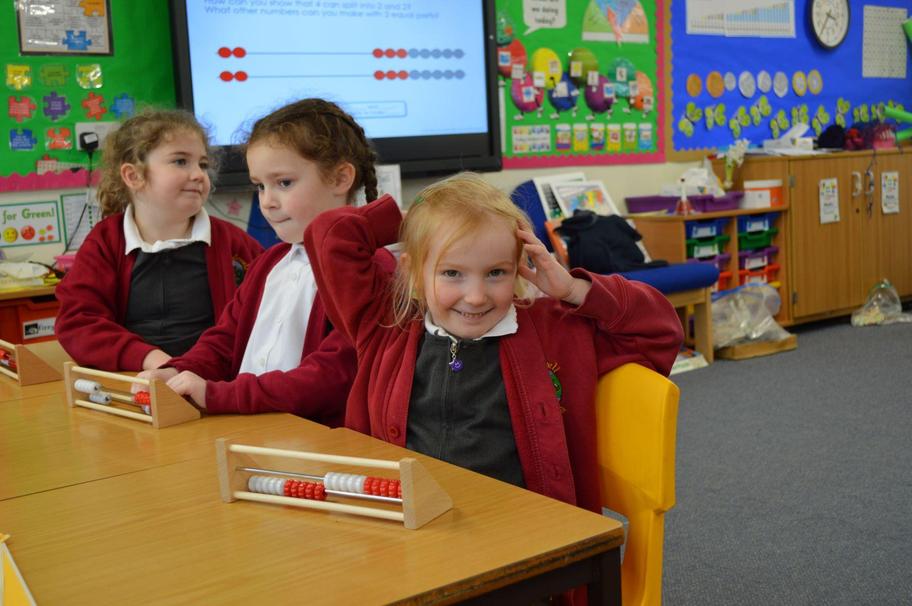
- Teachers making use of concrete, pictorial and abstract representations of mathematical concepts
- Learners being given the opportunity to ‘linger for longer’ or to ‘go deeper’ depending on individual need
- Pupils learning together, with ‘rapid grapsers’ moving onto challenge their understanding and solve rich and complex problems, while others consolidate their knowledge of the key concept.
Maths on Track meetings are held daily in addition to the formal mastery maths lesson. These have a number focus and promote rapid recall of key mathematical facts and develop a fluency in calculation.
Our Mastery Curriculum
- Reception classes work in line with the Early Years Foundation Stage Framework (2021) providing children with opportunities to develop and improve their skills in counting, understanding and using numbers, calculating simple addition and subtraction problems; and to describe shapes, spaces, and measures.
- At Key Stage 1 (KS1) the National Curriculum (2014) outlines the continuity and progression in maths and at Dinglewell Infant School.
- CanDoMaths Club medium term plans are used to plan cohesive learning journeys through the KS1 National Curriculum Programmes of Study
- Short term unit plans for maths detail the key learning points for each lesson. They also provide details of activities that offer ‘depth of challenge’ around the key learning point.
- Dinglewell Infant School has written a Calculation Policy in consultation with Dinglewell Junior School to clarify the continuity and progression in our approach to teaching addition, subtraction, multiplication and division. It has been designed to reflect the National Curriculum and is set out year-by-year.
Impact
- Assessment is ongoing, as the teacher needs to assess each child’s needs and abilities in planning how to deliver the maths curriculum. Same day intervention is offered whenever possible to enable pupils to be ready to move on.
- KS1 teachers are involved in assessing both attainment and progress. Judgements are made against the programmes of study that are laid out for each year group. Three times a year a periodic judgement is made to determine whether a child is working within Age Related Expectations. Judgements are shared at Pupil Progress Meetings and children requiring additional support are identified.
- Reception teachers complete Foundation Stage Profiles, making baseline judgements when children start school and assessing their attainment, against the Early Learning Goals in Numbers and Shape, Space and Measures, throughout the year.
- At the end of the Key Stage, Year 2 children will be assessed against national criteria using standardised assessment tasks. Results of these assessments will be reported to parents in their child's annual report.