Dinglewell Infant School
English
English
Intent
At Dinglewell Infants we want all our pupils to read well and develop a love of books and reading. Research shows that children who read and choose to do so for pleasure achieve better in all areas of the curriculum and have improved outcomes and opportunities in their adult life. A solid foundation in reading is the basis for success in writing and also contributes to children’s language skills as quality texts expose children to correct grammatical structures and vocabulary which is richer than that of typical everyday spoken language.
At Dinglewell Infants School we:
- Develop the fundamental skills of reading, writing and spoken English that are vital to support learning across the wider curriculum
- Inspire a love of reading and books
- Succeed in developing a rich vocabulary, in reading with meaning and being able to communicate through both written and spoken words
English and our Dinglewell Infant School Values
- Care – books are handled and stored with care.
- Co-operation – children share books and reading with their peers and are supportive learning partners, using their speaking and listening skills effectively.
- Creativity – writing allows children to be creative and the creativity of authors and illustrators is celebrated when books are shared.
- Honesty – children are trusted to tell staff if they haven’t finished their reading book and need to keep it for longer.
- Respect – feedback about written work is given sensitively and with respect for the writer and their work. Ideas are listened to and children understand that opinions about books and writing can differ.
- Responsibility – from the outset, children are given responsibility for handling the books they read, turning the pages and tracking the text. Children are responsible for the books that they read in school and take home. As they become more proficient readers, they are responsible for checking that what they read makes sense and correcting inaccuracies in reading.
Implementation
Spoken Language and Vocabulary
Children’s spoken language underpins the development of their reading and writing. Their acquisition and command of vocabulary is fundamental to their learning and progress across the whole curriculum. The quality and variety of language to which children are exposed greatly influences their understanding and use of vocabulary and grammar. All adults in school therefore provide significant role models of spoken language in their interactions with children.
Staff seek to develop and extend children’s vocabulary through their everyday interactions with the children and through direct teaching and learning in all areas of the curriculum. Our topic-based approach to the curriculum is highly conducive to this as children encounter, discuss, and revisit new vocabulary in a meaningful and familiar context.
We actively encourage children to talk in sentences and take advantage of opportunities for them to speak and develop their spoken language skills on a daily basis (through, for example, greeting the children individually as they arrive, asking them to articulate their dinner choices, providing opportunities for children to talk in pairs and groups).
Vocabulary is taught explicitly across the school. Subject plans clearly set out the key vocabulary that children will encounter and learn in each year group and topic, with particular emphasis placed upon ‘Tier 2’ words – i.e. those words that are high frequency words in many topics and content areas but are less likely to be encountered in speech.
Phonics
We follow a systematic synthetic approach to the teaching of phonics using the Essential Letters and Sounds programme. The aim of this programme is ‘Getting all children to read well, quickly’ which is an aim that we share at Dinglewell Infants. All staff are fully trained in implementing the programme and are careful to model the pure and correct pronunciation of sounds in order that children are able to do the same, leading to successful blending when reading words. The ELS programme provides clear structure and daily lessons to the end of Phase 5. Phase 6 is taught in Year 2 to the spelling requirements of the National Curriculum whilst continuing to reinforce and consolidate the phonics taught in Reception and Year 1.
In Year 1, children are assessed using Phonic Screening tests. These are used not only to track children’s progress in phonics, but primarily as a diagnostic tool to identify difficulties and next steps in learning which are then quickly addressed in subsequent teaching.
Children who do not meet the Phonic Screening Standard at the end of Year 1 receive small group phonics intervention teaching in Year 2, as well as individualised interventions in class. Whilst phonics is the most effective route to reading for almost all pupils, for a very small number of children this is sometimes not the case and an alternative method using analytical phonics is needed. This is taught, or overseen by, the SENDCo.
Whilst children learn to decode words phonetically, including both real and pseudo (‘alien’) words through phonics teaching, they are also taught the importance of understanding and responding to what they read, as this is what true reading entails.
Reading
We are passionate about the importance of books and the development of children’s reading skills. We believe teaching children the necessary skills for reading, and developing children’s interest in, and love of books, will encourage them to read for pleasure. We regard this as a priority as research has shown that children who read for pleasure achieve greater success in all areas of the curriculum.
- Class Texts - Storytime is a valued part of each class’s daily routine. In Key Stage 1, children have a minimum of one story time session every day, and in EYFS the children have at least three a day. These sessions provide an essential opportunity for children to enjoy listening to texts which are beyond their independent reading capability. Storytimes play a significant role in introducing children to new vocabulary, modelling fluency and enjoyment, and developing comprehension skills. Texts are therefore selected to:
- extend children’s vocabulary and develop their understanding of words and phrases;
- introduce children to the writings of a variety of authors;
- teach and reinforce English learning objectives;
- support the children’s learning and understanding in the class topic;
- familiarise children with a range of genres and text types
- inspire a love of books and reading.
- Focus texts – Key texts are identified from the class texts for specific year groups and particular topics. These books are chosen to ensure our children are exposed to a range of genres and authors as they progress through the school, and to teach specific curriculum content. These books are ‘off-limits’ to previous classes and in previous terms. Whilst in focus in the classroom, children hear these books read on several occasions, and by different adults. They are also readily available for children to return to as they build a repertoire of familiar stories and books that they are able to read and experience SUCCESS as a reader.
We have a Reading Spine document that sets out the texts that children should encounter throughout their time in the Infant school in order to be exposed to a variety of genres, authors and texts, which are recommended to address particular challenges in reading as identified by Doug Lemov. It is a working document as excellent new books are always being written and discovered, and so it may change year on year.
- Group Reading – Children in Key Stage 1 participate in weekly group reading sessions to DEVELOP their reading skills. Guided reading sessions may vary according to the age of the pupils, the text being explored and the needs of the children in the group. In these sessions, key word-reading skills and comprehension skills are specifically taught and practised in a small group. The books used include texts, which are fully decodable, and those with a controlled number of non-decodable words which enable children to encounter important topic-related vocabulary in context. Children explore a variety of non-fiction texts (Oxford In fact series), fiction (Traditional Tales, Story Sparks and Snapdragons) and poetry (Glow Worms series). Teachers select books carefully and plan a teaching focus for the group reading session. Guided Reading texts are stored in the library and are identifiable by a ‘guided reading’ stamp on the inside of the front cover.
- Individual Reading - We use fully decodable texts from the Oxford Reading Scheme to DEVELOP and support children’s individual reading skills in EYFS onwards. From orange book band, children have the necessary skills to be able to read texts, which are phonically based but begin to include other words which require the use of spelling knowledge and patterns taught in English. Books are carefully selected by teachers to ensure that they meet the needs of the child and are closely matched to their individual phonic level so that they SUCCEED as a reader. All children read individually to an adult at least once a week in school and take their new book home on a Friday to share with parents / carers. There is a clear expectation that children read these books four times a week to develop fluency and confidence. Age-related Individual Reading books are stored in classrooms and shared across vertical teams when necessary (i.e. classes 1, 4 & 7; classes 2, 5 & 8; classes 3,6 & 9)
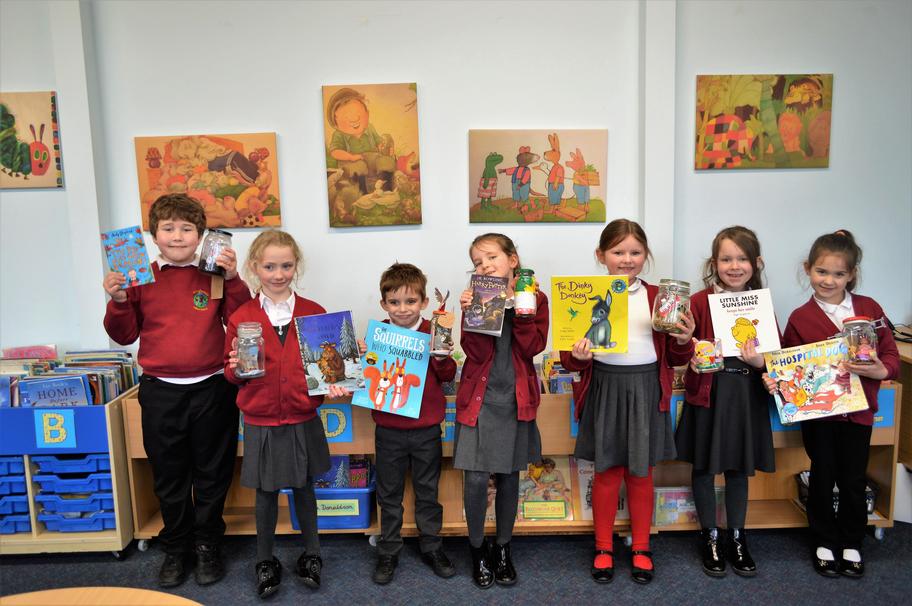
- School Library – Children have weekly library sessions and are able to select two books of their choosing from the library to take home. They are able to select from high-quality and up to date fiction, poetry and non-fiction, and to choose a book which they may not be able to read independently, but can enjoy sharing at home. In library sessions, children are also taught simple library and research skills. Our ‘Book of the Month’ introduces children and staff to a recently published book, and links with other texts and information about the author. Adults in school share and discuss this book with the children, and it then becomes a book which can be borrowed from the library. This helps to ensure that our library includes quality, up to date books with which children and adults are familiar, and is a key way in which we INSPIRE a shared love of books and reading across our school community.
- Classroom Reading Areas – Teachers ensure that the children in their class have access to a high quality, well-maintained and appealing reading area in their classroom. These areas contain books from the school library that are related to the class topic as well as well as a variety of other texts chosen by the children and teachers. Books which are used as focus texts in previous topics (including those used in previous year groups) also form a valuable part of the reading material available in the classroom as children can return to familiar to texts to develop their fluency and confidence as readers. Books are displayed in such a way that children are able to make informed and considered choices about the type of book they choose to read. Books are therefore displayed with the front cover clearly visible, or where this is not possible, books are organised according to genre and this is labelled clearly.
Our carefully structured reading approach enables our children to progress from learning to read when they enter Reception classes, to reading to learn as Year 2s.
Writing
Writing is an important form of communication and an extremely challenging task, particularly for our young learners. It requires children to draw on knowledge and skills in many areas simultaneously. Writing tasks are therefore broken down into smaller steps to make them more manageable. At its very simplest, children are taught from the very beginning to:
- Think it (decide what they want to write)
- Say it (say the sentence aloud and listen to how it sounds)
- Write it (write their sentence)
- Read it (read their sentence back to check that they’ve written what was intended)
These four steps provide a structure which is followed and built upon in each year group and enable children to practise composition, checking, editing and revising their writing by the time they leave Year 2.
Opportunities are carefully planned for children to write for a variety of purposes within a topic and to learn about different writing styles and structures. Staff seek to plan opportunities for children to write which are purposeful and motivating. Often, tasks are linked to the focus texts used in reading.
In order to reduce the load on children’s working memory when writing, we aim to make the transcription skills of spelling and handwriting as embedded and automatic as possible.
Handwriting
We use the Penpals handwriting scheme for daily handwriting lessons. Children learn the correct formation of letters in letter families in EYFS, and progress to learning letter joins in Yr1 and Yr2. All lessons are very structured and formal and we are careful to ensure that handwriting instruction is never an independent task in order to minimise the chance of children over-learning incorrect letter formation. All handwriting sessions begin with warm up exercises. Teachers organise seating for handwriting sessions to ensure that it meets the needs of individuals, paying attention to the requirements of left-handed pupils in particular.
Handwriting lessons build upon, and are complemented by, a rich foundation of other activities, which enable children to develop the physical and cognitive skills needed in order to write. Activities which develop children’s core strength are vital in order for them to use the fine-motor skills required to hold and write using a pencil, and adults teach and encourage good posture when working at tables.
Whilst whiteboards and pens are often used in lessons for quick response and ‘show me’ tasks, paper is always preferable as a writing surface as it allows the child greater control of their pen or pencil.
Spelling
Whilst children are taught to apply their phonic knowledge when segmenting words to spell them, they are also taught how to spell ‘Harder to Read and Spell Words’ (HRSW) – words which do not yet align with the letter-sound correspondences taught. Children begin learning this from Phase 2 of Essential Letters and Sounds in EYFS and this continues throughout Year 1 and Year 2. The HRSW children are expected to learn to read and spell are taught, practised, displayed and referred to, in classrooms. Dictation is sometimes used as a tool for children to practise the spellings have learned. When spellings have been learned, there is a clear expectation that children will use them in their writing. Whilst spelling is important, children are still strongly encouraged to be adventurous in their word-choices and not be restricted to only those words which they can spell accurately.
Impact
As children leave our school they have developed the skills to enable them to read successfully and have started to make the important transition from learning to read, to reading to learn. They recognise that texts can supply them with information and answer their questions. They choose to read and show a love of reading and can talk about books they have read and enjoyed. Their positive experiences of books and reading in our Infant School are the basis for continuing to read for pleasure. Children are engaged readers - their understanding of what they read is evident in the way in which they instinctively respond to texts, and ask questions as well as answering them. Children have developed the vocabulary and language skills to express their thoughts and ideas verbally and respond appropriately to others. They can communicate using the written word effectively as they have developed sufficient automacy in spelling and handwriting to allow them to focus on composing their writing.