Dinglewell Infant School
P.E.
Physical Education (P.E.)
Intent
We believe that teaching the children fundamental movement skills will enable them to develop key movements which can be applied to a range of sports and activities as they progress onto the Junior School and further. We recognise that many important aspects of Physical Education can be taught in a variety of scenarios and are not just a part of formal PE lessons. We work alongside other subject co-ordinators to develop a varied curriculum that educates them about the importance of health, wellbeing and fitness alongside the more physical areas.
At Dinglewell Infant School we strongly believe that quality PE is part of every child’s entitlement to a good education. We aim to fulfil their potential through a varied and interesting curriculum, hoping that every child will feel inspired to become physically active citizens that benefit from a life-long participation in sport and exercise.
We provide a safe and supportive environment for children to flourish in a range of different physical activities. Good differentiation within every lesson allows all children to succeed and improve their skills over time. Opportunities to compete in games, sporting events and competitions build character and help to embed values such as fairness, resilience and respect. We celebrate and share experiences and success regularly as a school and value the importance of recognising achievements at all levels.
At Dinglewell Infant School we:
- Develop key movements which can be applied to a range of sports and activities as they progress onto the Junior School and further
- Inspire our children to become physically active citizens that benefit from a life-long participation in sport and exercise and to fulfil their potential through a varied and interesting curriculum
- Succeed in improving our children's physical skills, ensuring participation for all.
Our school values/curriculum drivers underpin all that we do at Dinglewell Infant School and are integral to our P.E. provision:
- Care - we are kind and caring to all participants and understand that everybody’s abilities are unique to each individual
- Co-operation - in game situations we work as a team, positively encouraging each other and taking turns
- Creativity - we celebrate and share unique ideas when deciding how to move imaginatively or tactically when playing games
- Honesty - we play fairly and honour rules and decisions
- Respect - we respect all competitors regardless of individual differences (we encourage all)
- Responsibility - we use equipment and space safely and sensibly.
Implementation
Time Allocation, Teaching and Organisation
- In KS1 we are committed to providing each child with two hours of curriculum PE each week and 30 minutes of physical activity a day.
- The children are formally taught the fundamental movement skills and implement these during dance, gymnastics and games activities.
- They will also learn about the importance of health and well-being.
Resources
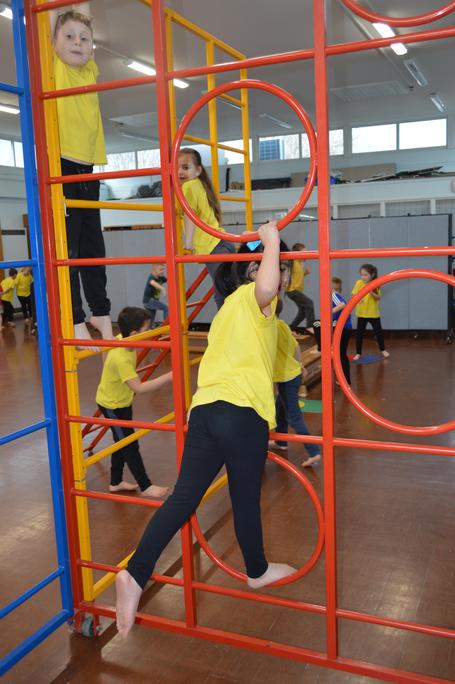
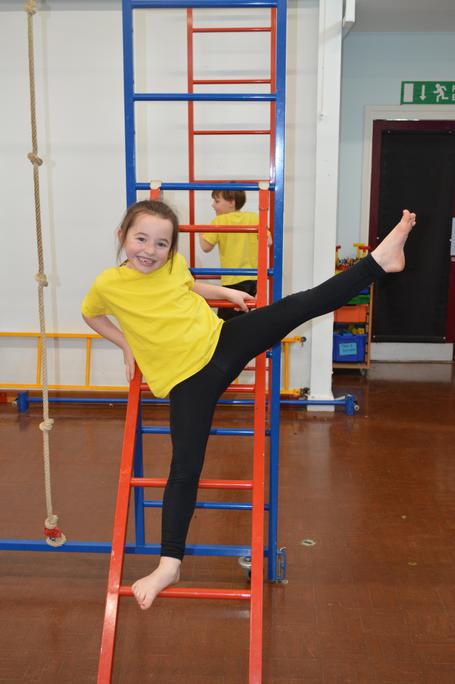
- The school has a wide variety of large and small apparatus including a trim trail, climbing wall and brig.
- EYFS have regular access to a tree house and a variety of equipment useful for physical activity.
- The playground and grass areas are available for physical activities in addition to the school hall.
- For Dance, we follow a scheme of work written by Sarah Shaw. Every teacher has a folder with relevant topic ideas and music. We also use BBC radio.
- Any defective equipment should be removed from use and the PE coordinator will be advised immediately.
- PE resources are stored centrally in the hall, accessible for all classes.
- A lunchtime Play Leader provides additional provision for the children to take part in during lunch times.
Equal Opportunities and Inclusion
- We believe in inclusive practice and all pupils have access to develop a broad and balanced curriculum irrespective of age, gender, cultural, ethnic and social backgrounds.
- Pupils with special needs will be supported, when necessary, where it affects their performance in PE, but independence will be encouraged where possible.
Planning
- Teachers follow the ‘Complete PE’ scheme of work. This clearly focuses on the fundamental movement skills and give clear examples for simplification or extension.
- A similar scheme is being written by the PE co-ordinator to follow planning and plan sessions that focus on key skills.
- We also aim provide opportunities to try new activities and experiences and see that we can be physically active in a huge variety of ways.
Assessment
- Assessment of physical education is a continuous process, which is carried out within the lesson by observing, asking questions and giving feedback to the children.
- The STEP (Space, Task, Equipment, People) theory is used to simplify skills and extend the higher achievers when necessary.
- We feel that targeted support when teaching fundamental movement skills are important in the moment in order to improve key skills long term.
- Each class teacher writes an annual report on physical education for every child in their class.
- Pupil voice allows us to check pupils understanding and experience of PE. The outcomes of these will be threaded into future planning or feedback and support for teachers.
Health and Safety
- We follow the LA safety policy for physical education, which is kept in the file in the PE cupboard.
- All fixed and portable PE equipment will be checked annually as organised by the school business manager.
- Firm discipline is essential at all times and noise should be minimal. Early lessons each year will focus on listening and responding safely.
- The children will wear PE kit. Parents are encouraged to provide trainers and jogging bottoms for outdoor PE. All earrings, including studs, will be taped before lessons. Long hair should be tied back with hair bands and clips removed.
- Staff dress appropriately to deliver the PE lesson effectively. Polo shirts and sweatshirts have been provided by the school for all teaching staff.
Impact
Cross-Curricular Links
Physical education shares many cross-curricular links. We work closely with other subject leaders to see where these links can be made.
- Many aspects of Heath link naturally to the Science curriculum.
- Well-being is an important aspect of the PSHE curriculum.
- Much of the topic information that the children learn in subjects like History, are easily translatable through our Dance curriculum and multiple schemes have been written to support this.
All of these help embed and reinforce key aspects of learning.
Extra-Curricular Activities
- We aim to offer a wide range of activities after school enabling KS1 to participate at some point during the school year.
- A yearly overview of events and activities provided by the School Sports Network is available each year.
- Extra-curricular clubs are varied and provided for each year group.
- Enrichment weeks and Sport events within school are planned for annually.
We hope that this, along with a rich curriculum will inspire a life-long love of sport and activity.
Planning and Assessment
Clear planning material during lessons will enable teachers to support children master key skills within lessons and improve them week on week. This should enable them to make good progress and apply key skills to game situations and specific sports when in KS2 and beyond.
Pupils with SEND achieve the best possible outcome and still leave with a positive experience of PE.
Skills Progression Map for PE
Vocabulary for PE